

How Much Money Does Tri-state Occupational Medicine Make From Social Security Admoinistration
This article offers a brief summary of the workers' compensation and Social Security Disability Insurance programs. Information highlighted includes the differences between the ii programs' types and terms of coverage. Information technology compares the differing patterns in workers' bounty and Social Security disability benefits as a percent of wages over the past few decades and considers the potential causes for such trends. The article besides explains the offset provision included in the 1965 Social Security Amendments, the intention behind the kickoff, and how and when offsets are practical.
The authors are with the National University of Social Insurance.
The findings and conclusions presented in the Bulletin are those of the authors and practice not necessarily correspond the views of the Social Security Assistants.
This fact sheet provides an overview of workers' compensation, Social Security Disability Insurance, and the interaction of these 2 programs. The information is based on presentations given at the policy research seminar, Interaction of Workers' Compensation and Social Security Disability Insurance, cosponsored by the National Academy of Social Insurance and the Social Security Administration. Coordination of inability benefits is recognized as a desirable public policy to ensure that disability payments come from the advisable program and that the total amount of disability benefits paid does not become a deterrent to return to piece of work.
Workers' Bounty
Workers' bounty provides benefits to workers who are injured on the job or accept a work-related illness. Benefits include medical treatment for piece of work-related weather condition and cash payments that partially supervene upon lost wages. Temporary total inability benefits are paid while the worker recuperates away from piece of work. If the condition has lasting consequences afterward the worker heals, permanent disability benefits may exist paid. In the case of a fatality, the worker's dependents receive survivor benefits.
Before workers' compensation laws were enacted, an injured worker's only legal remedy for a piece of work-related injury was to bring a tort suit confronting the employer and prove that the employer's negligence acquired the injury. Under the tort organisation, workers often did not recover amercement; those who did recover damages sometimes experienced delays or loftier costs in doing so. Although employers more often than not prevailed in court, they nevertheless were at risk for substantial and unpredictable losses if the workers' suits were successful. Ultimately, both employers and employees favored legislation to ensure that a worker who sustained an occupational injury or disease arising out of and in the form of employment would receive predictable compensation without delay, irrespective of who was at mistake. Equally a quid pro quo, the employer's liability was limited. Under the exclusive remedy concept, the worker accustomed workers' compensation equally payment in total and gave upwards the correct to sue the employer.
Workers' compensation programs are designed and administered past the states. The programs vary beyond states in terms of who is allowed to provide insurance, which injuries or illnesses are compensable, and the level of benefits. By and large, country laws require employers to obtain insurance or prove they have the fiscal ability to bear their ain adventure (that is, to self-insure).
Workers' bounty is financed virtually exclusively past employers, although economists point out that workers pay for a substantial portion of the costs of the program in the course of lower wages (Leigh and others 2000). The premiums paid by employers are based in function on the manufacture classifications of the employers and the occupational classifications of their workers. Many employers are also experience rated, which results in higher (or lower) premiums for employers whose past experience demonstrates that their workers are paid more than (or fewer) benefits than workers for similar employers in the same insurance classification.
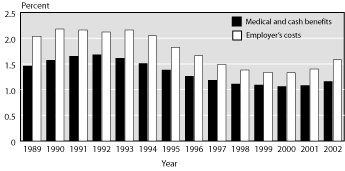
In 2002, workers' compensation covered 125.6 million workers (Thompson Williams, Reno, and Burton 2004). Total wages of covered workers were $iv.six trillion and full workers' bounty benefit payments were $53.4 billion, which amounted to $1.16 per $100 of covered wages. Employers' costs for workers' bounty—defined here equally premiums written for policies in the calendar year, payments made nether deductible arrangements, and the benefits and authoritative costs of self-insurers—were $72.ix billion. Benefits and costs have declined from a peak in the early 1990s (Chart 1).
Nautical chart 1.
Workers' bounty costs and benefits per $100 of payroll, 1989–2002
SOURCE: National Academy of Social Insurance estimates.
The difference between workers' benefits and employers' costs per $100 of covered wages is deemed for past expenses such as administrative and loss adjustment costs, taxes, and contributions for special funds, which tin include the support of workers' compensation agencies, and the insurers' profits or losses.
Social Security Disability Insurance
Workers' compensation in the United States is surpassed in size merely by the federal Social Security Disability Insurance and Medicare programs in providing greenbacks and medical benefits to disabled workers.
Although Social Security disability benefits and workers' compensation are the nation'due south two largest disability benefit programs, the two programs are quite dissimilar. Workers are eligible for workers' compensation benefits from their commencement day of employment, but Social Security disability benefits are paid simply to workers who accept a substantial piece of work history. Workers' compensation provides benefits for both short-term and long-term disabilities and for fractional as well as full disabilities. These benefits encompass only disabilities arising out of and in the grade of employment. In contrast, Social Security disability benefits are paid but to workers who have long-term impairments that forestall any gainful work, regardless of whether the inability arose on or off the job. By law, the benefits are paid only to workers who are unable to engage in whatever substantial gainful action by reason of a medically determinable physical or mental harm that is expected to last at least a year or result in death. The impairment has to be of such severity that the worker is not only unable to do his or her previous work simply is also unable to do any other type of substantial gainful piece of work. Social Security disability benefits begin subsequently a 5-month waiting period.
The corporeality of benefits that Social Security paid in wage-replacement benefits to disabled workers and their dependents in 2002 was nearly twice the amount of greenbacks benefits paid nether workers' compensation—$65.6 billion compared with $29.ii billion. Employer and employee each pay 5.iii percent of wages for Social Security's One-time-Historic period and Survivors Insurance and 0.ix percent for Disability Insurance. Thus, the total paid for Disability Insurance is 1.8 percent of taxable wages.
Trends in Social Security Disability Benefits and Workers' Compensation
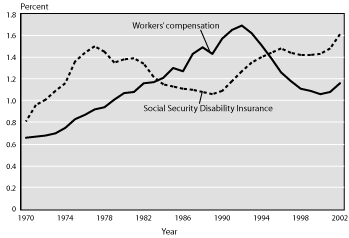
Social Security disability benefits and workers' compensation had unlike trends in benefits paid relative to covered payroll. Social Security disability benefits grew chop-chop in the early on 1970s and then declined through the late 1980s, after policy changes in 1977 and 1980 reduced benefits and tightened eligibility rules. From 1989 to 1996, Social Security benefits over again rose as claims and allowances increased during the economic recession of 1990–1991 (Chart ii). Since and then, benefits relative to covered wages have been fairly stable (Board of Trustees 2004).
Nautical chart 2.
Social Security Disability Insurance and workers' compensation benefits as a percentage of wages, 1970–2002
SOURCE: National Academy of Social Insurance, Workers' Compensation: Benefits, Coverage and Costs, 2002 (Washington, DC: NASI, Baronial 2004).
The tendency in workers' compensation benefits equally a share of covered wages follows a very dissimilar pattern. Total workers' compensation benefits (cash and medical combined) were less than Social Security inability benefits during the 1970s merely grew steadily throughout the 1970s and surpassed Social Security disability benefits in the mid-1980s. While Social Security inability benefits were flattening out during the mid-1980s, workers' bounty payments connected to grow at a rapid rate. Then, as workers' compensation payments declined every bit a share of covered wages after 1992, Social Security disability benefits rose.
The contrary trends in workers' compensation and Social Security disability benefits during much of the past 25 years raise the question of whether retrenchments in one plan increase demands placed on the other, and vice versa. The substitutability of Social Security disability benefits and workers' bounty for workers who have pregnant, long-term disabilities that are, at least arguably, work related, or might be exacerbated by the demands of piece of work, has received trivial attention by researchers and is non well understood (Burton and Spieler 2001).
The Offsets
An offset for concurrent receipt of workers' compensation was contained in the original 1956 Social Security inability programme, eliminated in 1958, and reinstituted in 1965. The 1965 Social Security Amendments required that Inability Insurance benefits be reduced when the worker is also eligible for periodic or lump-sum workers' bounty payments, so that the combined amount of workers' bounty and Social Security disability benefits does not exceed 80 percent of the worker's boilerplate electric current earnings. The combined payments after the reduction, yet, will never exist less than the corporeality of total Social Security disability benefits before the reduction. Average current earnings are defined as the highest of
- the boilerplate monthly wage on which the unindexed inability primary insurance amount is based,
- the average monthly earnings from covered employment and self-employment during the highest 5 sequent years after 1950, or
- the average monthly earnings in the calendar year of highest earnings from covered employment during the 5 years ending with the twelvemonth in which disability began.
Total earnings, including those above the Social Security taxable maximum, are used to determine average current earnings.
The intent of the starting time provision is to ensure that the combined benefits from workers' compensation and Social Security are not excessive. The commencement of Disability Insurance benefits applies to disabled workers nether the age of 65 and their families. Benefits for a worker's spouse or dependent children are showtime before the commencement is applied to the worker'due south benefit. Under the 1965 constabulary, the Social Security disability benefit will not exist reduced if the state workers' compensation law or plan provided for a reverse offset (a reduction of the workers' compensation do good of a worker besides receiving Inability Insurance).
The Omnibus Budget Reconciliation Act of 1981 (Public Constabulary97-35) ended the option for additional states to adopt reverse offsets. It also extended the Social Security inability starting time to utilize to certain public inability benefits paid by federal, country, or local governments. In particular, information technology applies to inability benefits that are earned in employment that is not covered past Social Security—for example, in jobs that are covered by the California Public Employees' Retirement Organisation and not by Social Security. At the time of the 1981 legislation, 16 states and Puerto Rico had contrary offset statutes, which remain today.
When a workers' compensation law provides for periodic payments but permits a lump-sum settlement that discharges the liability of the insurer or the employer, the settlement is bailiwick to the offset. In this case, the lump sum is prorated to reverberate the monthly rate that would have been paid had the lump-sum award not been made. Medical and legal expenses incurred past the worker in connection with workers' bounty may be excluded when calculating the outset.
Specifically excluded from these kickoff provisions are all Department of Veterans Diplomacy' benefits; needs-based benefits; federal, land, or local disability benefits that are based on employment that was covered by Social Security; and private alimony or private insurance benefits.
In Dec 2003, most vii.6 one thousand thousand beneficiaries (workers and dependents) received Social Security Disability Insurance benefits. Of those beneficiaries, about i.3 million, or almost 17 pct, had some connexion to workers' compensation or public disability benefits.ane That connection includes those who
- received workers' compensation or public disability benefits,
- had received workers' compensation or public disability benefits in the past,
- received a lump-sum settlement in lieu of periodic benefits, or
- had claims pending for workers' bounty or public inability benefits.
Of those with a connection to workers' compensation or public inability benefits,
- nearly i meg were disabled workers, and about 240,000 were dependents;
- well-nigh iii-fourths were connected to workers' compensation and 1-fourth to other public disability benefits;two and
- 53 percent of disabled workers had a awaiting connection or claim, and 47 per centum had a prior connection.
The percentage of Social Security Disability Insurance beneficiaries with a connection to workers' compensation or public disability benefits varies by state of residence, in function because workers' compensation programs vary, equally do rules for coverage of public employees under Social Security and alternative public disability benefits. Jurisdictions with the highest percentages of workers with a connectedness to workers' compensation or public disability benefits are California, Puerto Rico, Rhode Island, and Westward Virginia.
Jurisdictions with the lowest percentages include the District of Columbia (only 5 percent), Indiana (vii pct), Wisconsin (about 8 percent), and North Carolina (ix percent).
Notes
1 The ane.three meg includes a minor number of beneficiaries (1,851 workers and six,057 dependents) who are non currently receiving benefits because their unabridged do good is being offset.
two Excludes reverse showtime, no offset, or pending cases, which tin can be either workers' compensation or public disability benefits.
References
Lath of Trustees of the Federal Sometime-Historic period and Survivors Insurance and Disability Insurance Trust Funds. 2004. 2004 Annual Report. Washington, DC: U.Due south. Authorities Printing Office.
Burton, John F. Jr., and Emily Spieler. 2001. Workers' Compensation and Older Workers. Health and Income Security for an Aging Workforce, Brief No. 3. Washington, DC: National Academy of Social Insurance.
Leigh, J. Paul, Steven Markowitz, Marianne Fahs, and Philip Landrigan. 2000. Costs of Occupational Injuries and Illnesses. Ann Arbor: University of Michigan Press.
Thompson Williams, Cecili, Virginia P. Reno, and John F. Burton Jr. 2004. Workers' Compensation: Benefits, Coverage, and Costs, 2002. Washington, DC: National University of Social Insurance.
Source: https://www.ssa.gov/policy/docs/ssb/v65n4/v65n4p3.html
Posted by: josephboung1960.blogspot.com
0 Response to "How Much Money Does Tri-state Occupational Medicine Make From Social Security Admoinistration"
Post a Comment